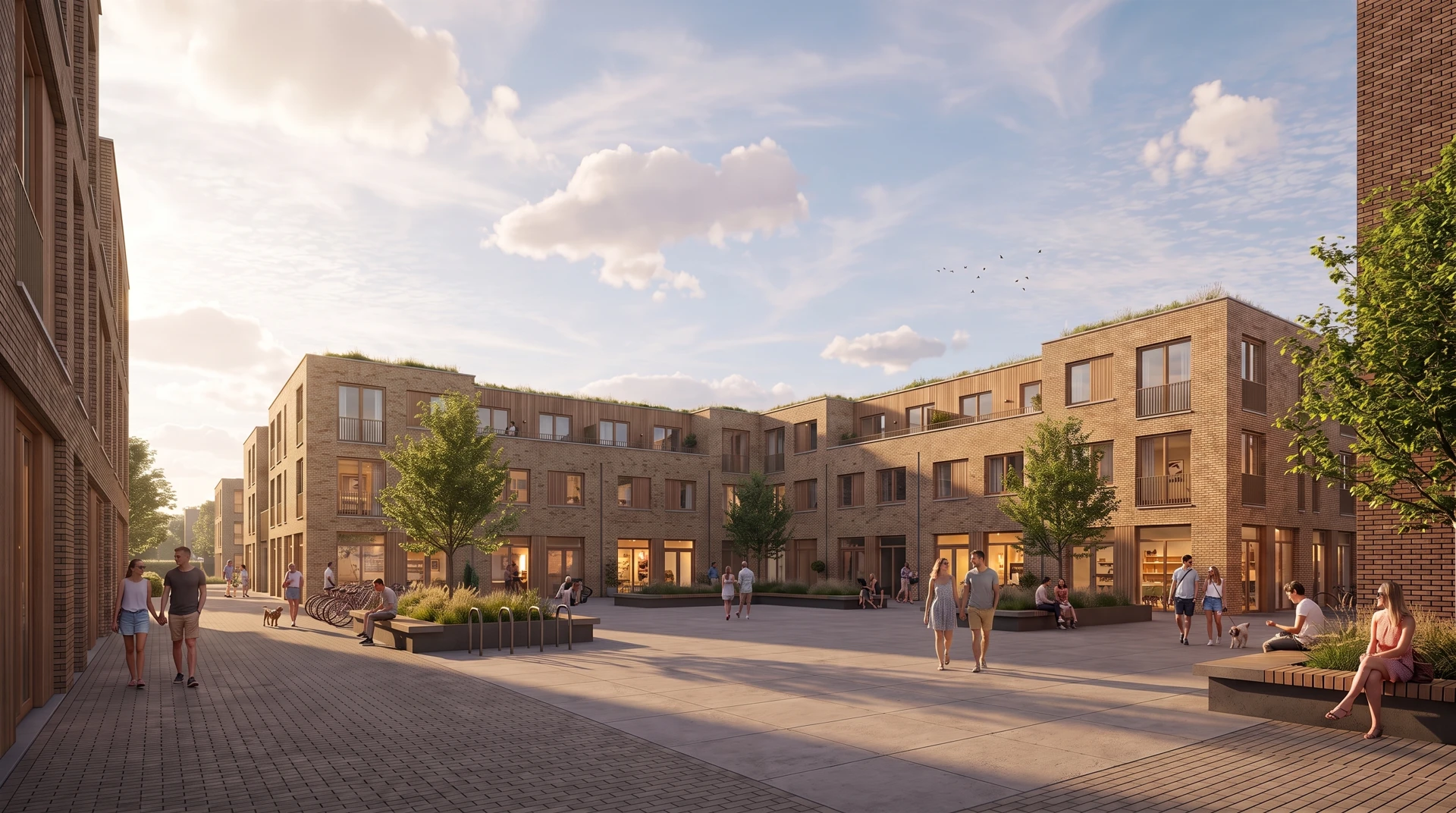
Whether you are a municipality, estate agent, property developer or architect, visualisation helps others understand what has yet to be built. A partner can help communicate that story clearly and carefully. Establish what the images need to achieve, then choose a process that fits.
Why engage a visualisation partner?
A design file is often clearer to its creator than to the person who needs to make a decision. A visualisation partner helps translate spatial information into an understandable presentation: how a building relates to its surroundings, how a space feels and what changes from the existing situation. Expertise in viewpoints, lighting, composition and presentation can add value.
For a municipality, images can support discussions about development plans, public spaces and design alternatives with residents, decision-makers and other stakeholders. A recognisable representation of the existing and proposed situations makes differences easier to discuss. Identify what has been decided and what remains exploratory.
For an estate agent, images help make a home or space imaginable before completion. Exterior and interior views within a coherent presentation can help prospective buyers understand layouts, atmosphere and possible uses. They support sales activity and conversations about the property. Identify indicative furnishings or finishes; a convincing image should not create misleading expectations.
For a property developer, visualisations serve several stages: explaining a proposal in a tender submission, discussing a scheme with stakeholders and later supporting sales or lettings. A partner who understands these purposes can help establish which images each stage requires and which underlying work can be reused.
For an architect, the aim is to make design decisions understandable to a client, evaluator or wider audience. This may involve a tender submission, a design review or an explanation accompanying a permit application. Design fidelity, context and identifiable versions are particularly important.
For a tender, the presentation should respond to the brief and evaluation criteria. For a permit application, visualisations can explain the proposal but do not replace required drawings, studies or other formal documents. Nor do they guarantee a contract award, permission or a sale. Their value lies in a clearer conversation about the proposal.
A partner is particularly useful when you lack the necessary image expertise, capacity or presentation support in-house. If you already have those capabilities, assistance with a specific part may be enough. Consider which contribution will move your project forward.
1. Choose what your project needs.
A facade image for a design review has different requirements from a complete sales campaign for a large development. Specialist styling, animation, location footage and a property finder can add value to the latter. A focused presentation may need only a few good images and a clear way to share them.
Start with the decision the presentation needs to support. Ask which parts of the proposal are essential to that purpose. A broad service offering is valuable when you use its breadth. Savings start with an appropriate scope.
2. Examine the distance between question and answer.
A large team does not in itself guarantee better collaboration. For a clearly defined project, a compact team with direct access to the person making the image can be a good fit. Particularly when the architect or interior professional has already made the design decisions.
Ask who understands your design, who implements changes and who approves them. Does a material change pass through several contacts? Or do you discuss it directly with someone familiar with the previous version?
Additional handovers can cause lost context, waiting and repeated explanations. That is avoidable overhead when they add no expertise or review. Agree on one accountable contact, with a clear replacement during absences. Direct communication needs to keep working when the team is busy.
3. Identify the decisions already made.
If you have designed the layout, materials and furnishings yourself, how much additional design or styling time is needed? Make that distinction explicit. You need a partner who can represent your decisions and identify missing information.
Ask what can be used from your existing model, views and references. Which parts genuinely need to be rebuilt or adapted? Request an explanation before approving the work. Reuse can reduce duplication, provided the supplied material is suitable and quality is checked.
Assess the portfolio for fidelity to the design too. Ask how discrepancies in proportions, materials or details are identified and resolved on a comparable project.
4. Test the collaboration with one change.
Ask how a specific revision would work: the same camera and facade, but a different brick colour. What is retained? What review follows? When will you receive the revision, and what will it cost?
This tells you more than the speed of a first image alone. A partner should explain which changes require a new production step and how many revision rounds the assignment includes.
A small paid trial can help. Agree on its purpose, fee and acceptance criteria beforehand. Compare the output and your own time spent briefing and providing feedback. You can then examine whether a more compact approach actually reduces work on your project.
5. Include the journey to the client.
Work often continues after rendering: selecting files, assembling a presentation, sending a link and checking what the client sees after each change. When these activities are organised separately each time, an inexpensive image can still require considerable time.
Ask how images, any motion and project information are delivered together. Can you update the presentation without rebuilding it? What is included in the price, and what additional setup or support is required?
PresentTool brings visualisation and a shareable project presentation together within the same product environment. This offers another way to organise the assignment: the designer takes an active role in creation and presentation. Whether it costs less also depends on how much work you can and want to do yourself. Compare that effort fairly with a fully managed service.
6. Compare the complete assignment.
Ask for proposals covering the same views, resolution, intended uses, revisions and delivery. Include your own time. A lower quote can cost more overall if substantial preparation and review shift to your team.
- Preparation: what do you supply, and what gets rebuilt?
- Coordination: who decides, how much discussion is needed and when will you receive answers?
- Revisions: what is included, and what does a new design variant cost?
- Delivery: which files, usage rights and presentation tools do you receive?
- Follow-up: what does an extra view or a change after delivery cost?
For AI-assisted work, include usage costs and review in this comparison. Automation can reduce recurring tasks, but it does not make production free. Ask where the process saves work in practice and how the partner maintains quality.
Choose a process that fits your design.
Studio size need no longer be a primary selection criterion. A modern visualisation partner should demonstrate how design understanding, appropriate tools and clear responsibility come together. A focused assignment may suit a compact team; a large production may call for more specialists.
The opportunities to save lie mainly in less duplicated work, fewer unnecessary handovers and a scope that matches your needs. Retain the expertise that improves the image. Ask what value every other step adds to your project.
Choose on the basis of a comparable assignment and a clear revision agreement. You can then assess both image quality and the time and cost required to make it useful.
Read next
Speed has not become cheap. Generation has become faster. ↗
About this Journal
PresentTool shares perspectives on professional design and visualisation practice. For architects, interior professionals, property developers and real estate professionals.
← All insights